
Creating New Graduation Traditions for

American-Born Desi Kids

Multi-generational South Asian family performing Namkaran ceremony

Your son graduates high school next month. Your parents want the same celebration they had for you—formal photos, traditional blessings, extended family gathering. But your son was born here. His cultural reference points include both Bollywood and Marvel movies. His friends are as likely to be named Emma and Tyler as Priya and Arjun.

So how do you create graduation traditions that feel authentic to his experience while honoring the heritage that shaped your family? The answer lies in building something entirely new—traditions that reflect your family's unique American-Desi journey.

Why New Traditions Matter

Traditional ceremonies can feel performative when they don't connect to your child's lived experience. But completely abandoning cultural elements leaves families feeling unmoored from their heritage.
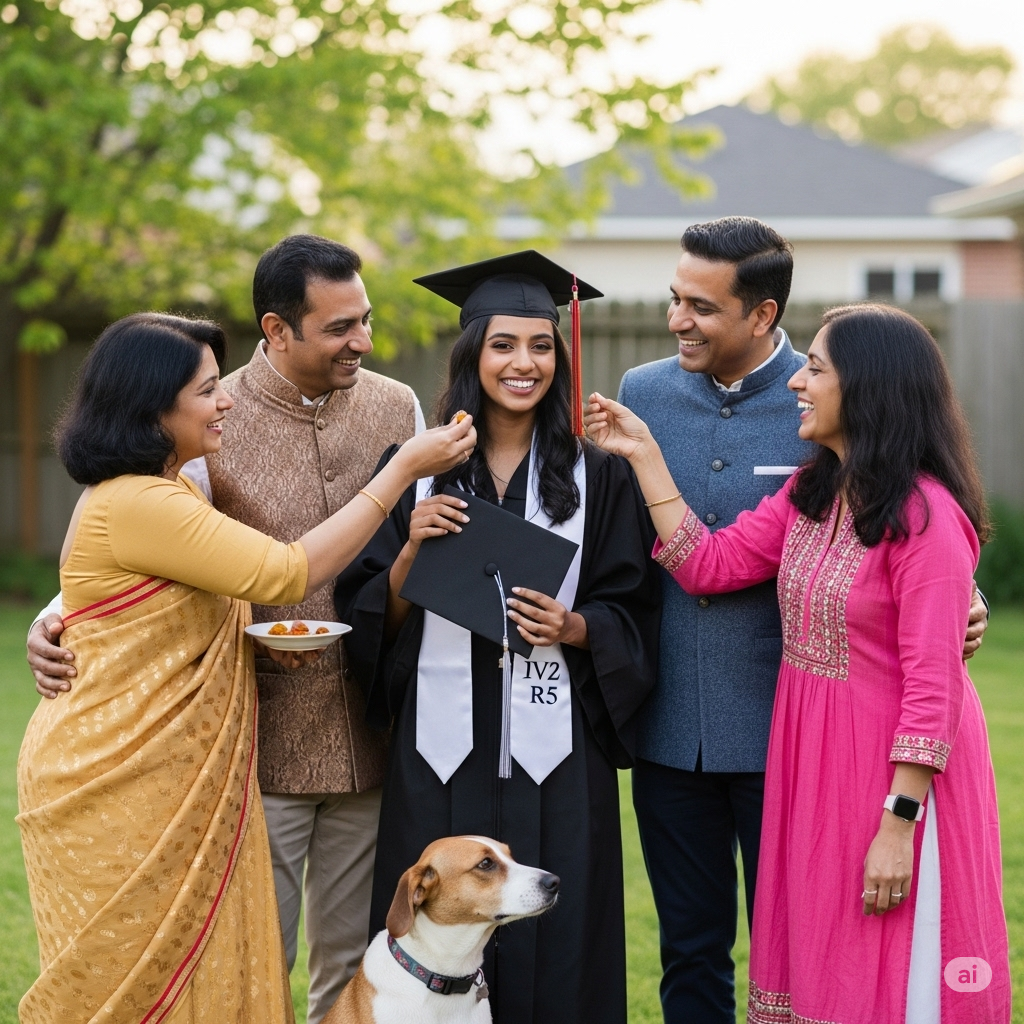
Graduation

The solution? Create hybrid traditions that honor both where you came from and where you're going. Meera Patel, whose daughter graduated from Northwestern last year, puts it perfectly: "We couldn't just transplant my mother's graduation celebration from Delhi to Chicago. But we also couldn't pretend we were just another American family. So we created something that was uniquely ours."

The Family Meeting That Changes Everything

Authentic to Your Family's Story

Your traditions should reflect your actual journey, not an idealized version of either culture. If your family arrived when your kids were young, include elements that acknowledge their adaptation. If you're second-generation, honor both your parents' immigrant experience and your American reality.

Meaningful to Your Graduate

Ask yourself: Does this tradition reflect my child's values and experiences? If they've never connected with Sanskrit prayers, don't force them now. If they love storytelling, build that in. If they're passionate about social justice, incorporate gratitude for educational opportunities.

Sustainable for Future Generations

Create traditions simple enough that your children will want to continue them with their own kids. Elaborate productions often die with the generation that created them.

Building Your Family's Graduation Culture

Family’s Journey

Start with Your Story Every family has a unique immigration and integration story. Build traditions that acknowledge this journey.

The Distance Celebration

If family sacrificed to come to America for better education, measure the literal distance from your ancestral village to your child's school. Create a visual representation—a map, a photo journey, or even a small ceremony acknowledging that geographical and cultural journey.

The Generation Photo

Take a photo showing what education looked like for each generation. Great-grandmother who learned to read at 40. Grandmother who finished high school. You with your college degree. And now your graduate. The visual progression tells your family's story.

Practical New Traditions That Work

The Legacy Letter Exchange

Have each family member write a letter to the graduate about what their education means to the family. Include practical advice, emotional support, and family history. Present these during a private family moment. Then have the graduate write letters to future family members, to be opened at future graduations.

The Gratitude Tree

Create a visual representation of everyone who contributed to this achievement. Use a large poster or actual tree branch. Have family members write names of people who helped—teachers, friends, relatives who sent money, neighbors who provided rides. Make it clear that achievement is community effort.

The Cultural Time Capsule

Include items that represent both cultures: a traditional sweet alongside the graduate's favorite American snack, a family photo next to their favorite American novel, traditional music with their graduation playlist. Open at a future milestone.

The Service Commitment

Many Desi families emphasize education's responsibility to serve others. Create a tradition where graduates commit to using their education to help someone else. This could be mentoring younger students, volunteering in their field, or supporting family members' education.

Regional Adaptations for American Families

For Punjabi-American Families

Adapt the concept of "Deg" (community sharing) by having neighbors and friends contribute one dish to the graduation feast, emphasizing how community support made this achievement possible.
[object Object]

For Tamil-American Families

Create a modern "Saraswati Vandana" where family members each share one book, skill, or piece of knowledge they hope the graduate explores next.
[object Object]

For Gujarati-American Families

Build on business and education values by having the graduate present a "business plan" for their next life phase to extended family, combining cultural emphasis on entrepreneurship with American goal-setting.
[object Object]

For Bengali-American Families

 Honor the cultural love of learning by creating a family "university" where each generation teaches something to the others—grandparents teach traditional skills, parents teach life lessons, graduates teach technology.
[object Object]

Managing Cultural Code-Switching

American-born Desi kids are cultural code-switchers by nature. Your graduation traditions should acknowledge this reality, not fight it.

The Two-Part Celebration

Host a cultural celebration for extended family and a different celebration for friends. This isn't segregation—it's recognition that different communities celebrate differently. Your graduate can be fully authentic in both spaces.

The Explanation Tradition

Build explanation into your traditions. When you perform cultural elements, have someone explain their significance in terms that make sense to American friends. This creates inclusion rather than exclusion.

The Choice Element

Give your graduate agency in how they participate. Maybe they want to wear traditional clothes for photos but modern clothes for the party. Maybe they want the blessing ceremony but not the extended family speeches. Honor their comfort level.

Traditions That Bridge Communities

The Friendship Appreciation

Since American-born Desi kids often have diverse friend groups, create traditions that honor these relationships. Have friends share what they learned from your family's culture. This creates mutual appreciation rather than cultural performance.

The Community Impact Recognition

Acknowledge how your graduate's achievement impacts both the Desi community and their broader American community. This helps them understand their role as cultural bridges.

Technology Integration

The Virtual Family Toast

Connect with family members globally for a virtual celebration. Have relatives from India, Canada, or other parts of the US join for key moments.

The Digital Storytelling Project

Create a video that tells your family's education story, from earliest generations to the present. This becomes a family heirloom and a way to preserve stories for future generations.

The Social Media Tradition

Create a family hashtag and have everyone post their favorite memories of the graduate's educational journey. This creates a digital scrapbook and acknowledges how modern families document milestones.

Making It Sustainable

The best traditions are simple enough to maintain and flexible enough to evolve.

Simple Structure, Deep Meaning

Focus on one or two elements that carry significant meaning rather than elaborate productions.

Annual Evolution

Allow traditions to grow and change. What works for high school graduation might need adaptation for college or graduate school.

Next Generation Input

As your graduate becomes an adult, involve them in refining these traditions. They might add elements for their own children that you never considered.

The Long Game

You're not just creating graduation traditions—you're modeling how to honor heritage while embracing change. Your graduate will use these skills throughout their life as they navigate their own cultural identity.

When they have children, they'll remember that families can create meaningful traditions rather than simply inheriting them. They'll understand that culture is living, breathing, and adaptable.

The Ultimate Goal Create traditions so meaningful that your graduate wants to continue them. Build celebrations that feel authentically yours—not borrowed from either culture, but created by your family's unique journey. Because that's what American-Desi families do best: we take the best of both worlds and create something entirely new. Something that honors where we came from while celebrating where we're going. Something that's finally, completely, authentically ours.
Elegant wedding reception with floral centerpieces

Your Celebration, Our Circle

Find your dream team. Celebrate with EverlyUs